


Hello you,
As promised, I wanted to share with you all the useful snippets from previous newsletters. In this published post (which I did not send to you all via email, as I wanted to protect your mailbox) you’ll find four tools that you can refer back to.
Take care, Lucy xo
A little learning: self-sabotage check-in
Since we’re on the subject of hiding your best work... Let’s look at self-sabotage:
You know the moment. You’ve just landed the extension, or the rate rise, or the reference that proves you’re brilliant at this. And instead of sitting in it for five minutes, you’re already bracing. Wondering if they’ll notice you don’t actually know everything. Triple checking the invoice. Saying yes to scope you didn’t quote for because saying no felt riskier than the burnout.
That’s not just imposter syndrome showing up again. That’s a saboteur, and contracting gives them a lot to work with.
Positive Intelligence work (Shirzad Chamine) calls it the Judge, the inner voice that finds the flaw first, in you, in the client, in the contract you should have negotiated harder. It brings friends. The Hyper-Achiever who can’t let a good gig just be a good gig without immediately chasing the next one. The Hyper-Vigilant one already scanning for when this contract ends, even in week two. The Pleaser who over-delivers because being needed feels safer than being paid what you’re worth. The Controller who won’t hand anything off, even when the workload’s unsustainable. The Avoider who “means to” raise the rate conversation and never quite does. The Stickler who reworks the deliverable four times past done.
For contractors, these aren’t quirks. They’re the reason brilliant women undercharge, over-function, and burn out on contracts that should have been the good part. The instability of the work makes the saboteurs louder, and the saboteurs make the instability feel worse. That’s the loop that has to break if this is meant to be sustainable, not just survivable.
Sit with these for a second:
Where in your business or your day rate are you making yourself smaller than the evidence supports?
What would you do differently this week if you fully believed you were good enough already, not “good enough once X happens”?
Whose voice is that, really, when you talk yourself out of pitching for something?
No need to answer out loud. Just notice.
Information, information, information.
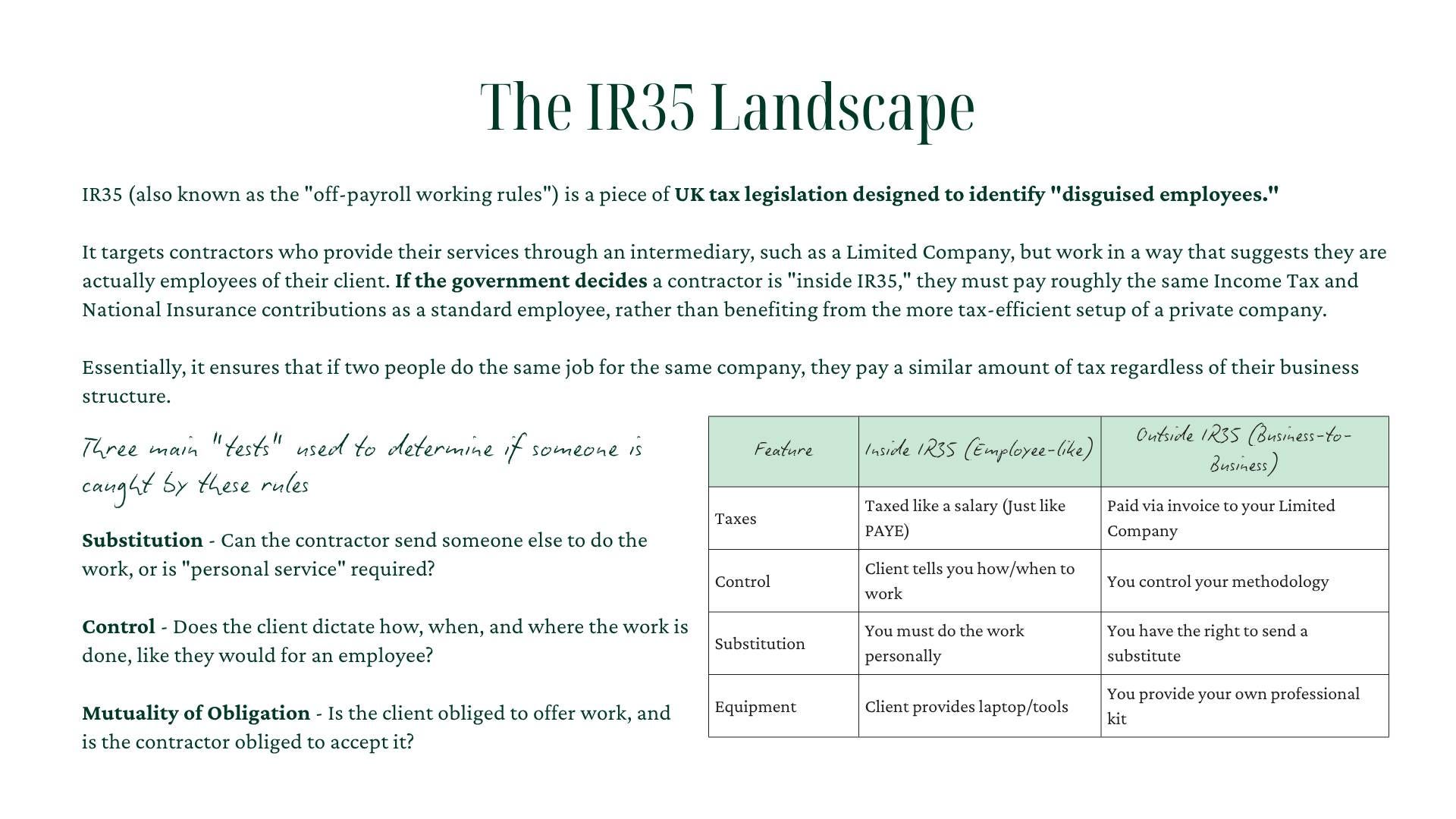
Now we’re getting into the swing of things, I wanted to share with you a few bits of key info each month. Firstly, for the newbies and those unsure on IR35, here is a snapshot.
Personal Development Coaching Tool: Mid-year goal setting.
The Transformational Goal Process (Using the Wheel of Career / Life.)
This process uses a twist on the classic “Wheel of Life” - we’re focusing purely on career.
Step 1: The Wheel of Career – What’s Really Going On?
Split your career into eight segments to explore where you’re thriving and where things feel stuck. You can do this visually as a circle, or list them out.
![44 The Career Wheel - How to Have a Brilliant Life, 2nd Edition [Book]](https://substackcdn.com/image/fetch/$s_!28qj!,f_auto,q_auto:good,fl_progressive:steep/https%3A%2F%2Fsubstack-post-media.s3.amazonaws.com%2Fpublic%2Fimages%2Fee4d8a2d-1bfc-4801-aa3f-8046108564fe_536x457.png "44 The Career Wheel - How to Have a Brilliant Life, 2nd Edition [Book]")
Here are some (further) suggested segments:
Fulfilment: Does your work energise and mean something to you?
Growth & Learning: Are you stretching and developing new skills?
Money & Rewards: Are you earning what feels fair and supportive?
Work-Life Blend: Do you have time for life outside work?
Values Alignment: Does your work reflect who you are?
Purpose & Direction: Are you heading somewhere that feels right?
Confidence & Presence: Are you showing up powerfully?
Environment & People: Do you feel safe, seen, respected?
Score each out of 10.
Then ask: Where is the biggest gap between where I am and where I want to be? Which area, if it shifted, would have the biggest positive impact on everything else?
This becomes the anchor for your transformational goal.
Step 2: Set a Transformational Goal
Now craft a bold, identity-based goal that reflects the future version of you – the one who’s already living this change. Use the language of becoming.
Start with “I AM…”
Examples:
“I am a sought-after consultant who sets my own schedule and earns with ease.” “I am the creative director of a brand I believe in, and I wake up excited.” “I am a confident, visible leader in my field, known for my ideas and impact.”
This isn’t about the how yet. This is about claiming it. Feeling it. Owning it.
Step 3: Break It Down – Objectives
Now let’s turn that big goal into 3-4 clear objectives. These are milestones — things you can measure and check in on.
Example goal: “I am a confident, visible leader in my field, known for my ideas and impact.”
Your objectives might be:
Build a clear personal brand and online presence.
Speak at one industry event this year.
Launch a thought leadership series (e.g. podcast, blog, newsletter).
Develop inner confidence to handle visibility and pushback.
Step 4: Smaller Steps – Make It Doable
Break each objective into smaller actions. Keep it real, keep it human. You’re not a robot. These should be things you can actually do, even on tired or self-doubt-y days.
Let’s use Objective 1: Build a clear personal brand and online presence.
Smaller steps: Book a 2-hour session to define your niche and message. Write your bio and update your LinkedIn. Start showing up weekly on your chosen platform. Engage with 3 people per week in your space. Set a monthly review to track progress.
Step 5: Timeframe
Don’t rush it, but don’t drift either. Set clear windows.
Break it into phases:
Month 1–2: Discovery & foundation Month 3–4: Visibility & output Month 5–6: Stretch goals & evaluation
*Hint, at the end of this book, I have created a 180 day journal prompt for you, which will help you build some of this out.
Use a calendar. Block time. Honour it like you would a client.
Step 6: Resources – What Will You Need?
You’re not meant to do this alone. What will support you?
A coach or mentor Time blocked out weekly Budget for training or branding Supportive community or accountability group Tools (e.g. website, planner, Canva, etc.)
Also: energy, patience, self-belief. Build rituals that protect and top those up.
Step 7: Threats & Roadblocks – Name Them
We all hit walls. Let’s name them early and plan for them, without judgment.
Potential threats:
Self-doubt and imposter syndrome Other people’s opinions (especially if you’re changing lanes) Lack of time or boundaries Comparison or perfectionism Money fears
Build your response plan:
Who will you call when doubt kicks in? What’s your plan when you fall off track? What boundaries do you need in place?
Step 8: Loop & Reflect
Set monthly check-ins to reflect:
What’s shifted? What’s working? What feels sticky or misaligned? What needs tweaking?
Transformation is messy. It’s rarely a straight line. Stay in the loop with yourself... this is an evolution, not a sprint. You don’t need to know every step. You just need to know what’s calling you and commit to becoming the version of you who answers it.
So, go back to your “I AM” statement. Sit with it. Say it aloud. Let it start to feel true.
And then... take the next small step.
P.S. Share you I AM statement with us in the Community Forums! I’d love to hear how you got on.
Ideas: Other ways to make money as a contractor
Last month I shared a coaching activity for your personal development, this month I am here to give you some ideas for your business development:
So, hands up if your entire income right now depends on one client. One contract. One hiring manager not changing their mind.
Yeah. That’s a lot of us.
And look, there’s nothing wrong with a good day rate. That’s why we’re here. But I want to talk today about what happens when we stop thinking of ourselves as people who sell time, and start thinking of ourselves as people who have something genuinely valuable to offer - in more than one way:
1. Turn your network into a revenue stream - Referrals and associate work are the most underused income streams in contracting. Ask specifically, arrange referral fees, and remember your network isn’t just support - it’s potentially your supply chain.
2. Sell your knowledge, not just your time - Training, workshops, and writing are all ways to monetise what you already know. Clients often have separate budgets for learning and development that are easier to access than contracting headcount.
3. Package what you do into a product - A fixed-price audit, a toolkit, a framework... anything with a clear scope and a defined output can be priced on value rather than hours. That’s a product, and products scale in ways that timesheets don’t.
Here’s your homework: Out of these 3, pick one and give it go for July. Let us know how you get on. What worked well? What didn’t?

